Outdoor Lighting Ideas for Popular Houston Home Styles
Outdoor lighting for Houston home styles should highlight the architecture, landscaping, and design details that make each property different.
A lighting plan that looks beautiful on a traditional brick home may not be right for a modern stucco property. The fixtures, beam angles, brightness, and focal points should change with the house.
Houston has a wide mix of home styles. Some neighborhoods have historic bungalows shaded by mature trees. Others have traditional brick homes, modern custom properties, large Mediterranean-style houses, ranch homes, or luxury estates.
Each one presents a different lighting opportunity.
At Houston Lightscapes, we study the property before deciding where fixtures should go. We look at the shape of the home, the building materials, the roofline, the entry, the landscaping, and the way the property will be viewed after dark.
The goal is not to cover the house with light.
The goal is to reveal its best features.
Why the Style of the Home Matters
Outdoor lighting becomes part of the home’s appearance after sunset.
During the day, the architecture is easy to see. Brick, stone, windows, columns, roof peaks, trim, and landscaping naturally create depth.
At night, those features can disappear.
Poorly planned lighting may make the home look flat, create harsh bright spots, or draw attention to areas that were never meant to become focal points.
A custom design solves that problem by considering the home as a whole.
The lighting should support the architecture instead of competing with it. A formal home may benefit from balanced lighting around columns and entryways. A modern home may look better with fewer fixtures, clean lines, and carefully controlled beams.
The home tells us where to begin.
Outdoor Lighting for Traditional Brick Homes
Traditional brick homes are common throughout Houston, Memorial, Tanglewood, West University, Bellaire, and many surrounding communities.
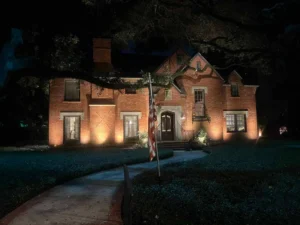
Brick responds well to warm outdoor lighting. The light can bring out the color, texture, and depth of the masonry without making the surface look washed out.
Common features on traditional Houston homes include:
- Brick walls
- Front columns
- Gabled rooflines
- Covered entries
- Bay windows
- Dormers
- Decorative shutters
- Mature trees
- Curved walkways
Uplighting can be used to highlight columns, corners, and roof peaks. Wider beams may be used across larger brick surfaces, while narrower beams can draw attention to a front entry or architectural detail.
Fixture placement is important.
A fixture placed too close to a brick wall may create a bright spot near the ground and leave the upper section dark. A fixture placed at the right distance can spread the light more evenly and show the full height of the home.
The front entry should usually receive special attention. Warm lighting near the doorway can make the home feel welcoming and help connect the walkway to the house.
Large trees can also frame a traditional home. Lighting selected trees adds depth and prevents the house from looking like a bright object surrounded by darkness.
Outdoor Lighting for Modern and Contemporary Homes
Modern homes need a more controlled lighting approach.
These properties often have clean lines, flat or low-pitched roofs, large windows, smooth stucco, metal accents, and simple landscaping. Too many fixtures can weaken the design by making the exterior feel busy.
Less can be more.
A modern outdoor lighting plan may focus on:
- Strong vertical or horizontal lines
- Smooth exterior walls
- Floating steps
- Large entry doors
- Courtyard walls
- Sculptural trees
- Modern planters
- Water features
- Geometric walkways
Narrow beams can create sharp columns of light on tall walls. Soft wall washing can show the shape of a courtyard or entry without producing harsh spots.
Color temperature also matters.
Lighting that is too yellow may not match the clean appearance of a modern home. Lighting that is too cool may feel harsh and commercial. The right temperature should complement the exterior materials and the atmosphere the homeowner wants to create.
Modern properties also tend to have large windows. Fixture angles must be controlled so light does not shine directly into the home or create distracting reflections in the glass.
The finished result should look simple, even when the design behind it is highly detailed.
Outdoor Lighting for Mediterranean and Stucco Homes
Mediterranean-style homes often have tall elevations, stucco walls, arches, balconies, tile roofs, columns, and detailed front entries.
These homes can look dramatic after dark, but they can also be easily overlit.
A large wall does not always need one extremely bright fixture. Several lower-output fixtures may give the designer more control and create a softer result.
Outdoor lighting can be used to highlight:
- Arched windows
- Entry towers
- Columns
- Balconies
- Textured stucco
- Tile rooflines
- Courtyards
- Palm trees
- Fountains
- Decorative gates
Narrow uplights can emphasize tall columns or entry towers. Wider beams may help reveal the shape of stucco walls. Small fixtures can bring attention to arches, stone accents, or landscaping near the base of the home.
Stucco reflects light differently than dark brick or stone. A fixture that works well on one material may look too bright on another.
That is why brightness should be selected according to the surface being lit.
A Mediterranean-style home may also have several layers of architecture. The design should create a clear focal point instead of giving every wall and roof peak the same level of attention.
Usually, the entry should stand out first. Secondary features can then support it.
Outdoor Lighting for Ranch-Style Homes
Ranch-style homes are usually wider than they are tall. Many have long front elevations, low rooflines, attached garages, large front windows, and mature landscaping.
The challenge is creating visual interest across the width of the property.
Using identical fixtures at equal distances can make the home look repetitive. A stronger plan selects important features and creates a natural rhythm across the front elevation.
Lighting opportunities may include:
- Brick or stone sections
- Front porches
- Chimneys
- Large windows
- Garage corners
- Walkways
- Garden beds
- Large oak trees
- Driveway entrances
Because ranch homes sit lower to the ground, trees and landscaping often play a major role in the final design.
Lighting a large oak can add height to the scene. Highlighting layered garden beds can create depth between the street and the house. Soft lighting near the porch can make the entry easier to recognize.
The garage should be handled carefully. It may take up a large part of the front elevation, but it does not always need to become the brightest feature.
The lighting should guide attention toward the home’s living areas and entry.
Outdoor Lighting for Bungalows and Craftsman Homes
The Heights and other established Houston neighborhoods have many bungalows and Craftsman-style homes.
These properties often include front porches, tapered columns, exposed roof details, wood siding, brick piers, and smaller front yards.
The lighting should feel warm and inviting.
A bungalow usually does not need the same fixture count or brightness as a large estate. The design can focus on a few meaningful features:
- Porch columns
- Front steps
- Walkways
- Gable details
- Mature trees
- Garden beds
- Brick or stone piers
- Entry doors
Porch lighting should work with the landscape lighting. If the porch fixtures are very bright, nearby accent lights may disappear. If the porch is too dark, the entry may not feel connected to the yard.
Balance matters.
Historic homes may also have limited planting space near the foundation. Fixtures must be placed carefully so they do not crowd the landscaping or become too visible during the day.
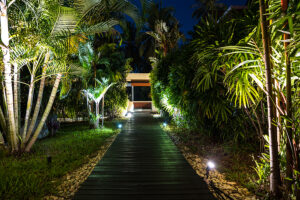
Moonlighting from mature trees may be a strong choice for these properties. It can create soft light across a walkway, lawn, or porch without filling the small yard with fixtures.
Outdoor Lighting for Large Custom and Estate Homes
Large Houston homes often include several rooflines, wings, courtyards, driveways, trees, outdoor living spaces, and architectural materials.
These properties need a full lighting plan.
Lighting only the front wall may leave the property feeling unfinished. The driveway, entry, landscaping, and surrounding trees should help lead the eye toward the home.
A complete estate lighting design may include:
- Architectural uplighting
- Driveway lighting
- Gate and column lighting
- Tree lighting
- Moonlighting
- Path lighting
- Courtyard lighting
- Patio lighting
- Pool-area lighting
- Garden lighting
- Water-feature lighting
The size of the property does not mean every area should be bright.
Large homes benefit from layers. The strongest light may be placed near the entry or main architectural feature. Softer lighting can support secondary walls, trees, gardens, and walkways.
The property should have a clear visual order.
What should someone notice first?
What should they see next?
A well-designed system answers those questions without making the lighting itself feel obvious.
Match the Lighting to the Exterior Materials
The style of the house is important, but the exterior materials also affect the design.
Brick, stone, stucco, wood, glass, and metal reflect light in different ways.
Dark brick may absorb more light and require a different output than light-colored stucco. Rough stone creates shadows and texture when the light crosses it at an angle. Smooth walls may show bright spots more easily.
Glass requires glare control. Metal surfaces can reflect concentrated light. Wood siding often looks best under warm, soft lighting.
We consider:
- Surface color
- Surface texture
- Fixture distance
- Beam width
- Light output
- Viewing angle
- Nearby windows
- Existing porch lights
These details help us choose the right fixture for each part of the home.
Connect the Architecture to the Landscape
The house should not look separated from the yard.
Architectural lighting may highlight the home, but landscape lighting creates the setting around it.
A large tree can frame the front elevation. A garden bed can create a soft transition between the walkway and the walls. Path lighting can lead visitors toward the entry. Driveway lighting can introduce the property before the home comes fully into view.
This connection is especially important on Houston properties with mature trees and thick landscaping.
If the home is brightly lit and the yard is completely dark, the property may feel flat. If the trees are bright but the entry is hard to find, the design lacks direction.
Each lighting zone should support the others.
Professional landscape lighting design brings the architecture, gardens, walkways, trees, and outdoor living areas into one plan.
Avoid Using the Same Lighting Layout on Every Home
Outdoor lighting should not be installed according to a standard fixture pattern.
Placing one light at every corner may illuminate the building, but it does not create a custom design.
The better questions are:
- Which features make this home distinctive?
- Where does the architecture change direction?
- Which materials should be highlighted?
- How will people view the property?
- Where are the windows and seating areas?
- Which trees help frame the home?
- Where do people need better visibility?
The answers will be different for every property.
Even two brick homes on the same street may need different designs because of the roofline, landscaping, setback, and viewing angle.
Custom lighting begins by seeing the home as an individual property.
Frequently Asked Questions About Lighting Different Home Styles
Does outdoor lighting need to match the style of my home?
Yes. The fixture placement, brightness, beam shape, and focal points should support the home’s architecture. A modern home usually needs a different design than a traditional brick or Mediterranean-style property.
What color of light looks best on a brick home?
Warm white lighting often works well with brick because it brings out the natural red, brown, and earth tones. The exact color temperature should also match nearby stone, trim, and existing exterior lights.
Can outdoor lighting make a small house look larger?
Lighting can create more depth by highlighting selected architectural features, trees, and landscaping. It will not change the size of the house, but it can give the property a more complete and layered appearance after dark.
Should every side of the house be lit?
Not always. Lighting should focus on the areas that are visible, used after dark, or important for safety. Some darker areas are needed to preserve contrast and prevent the property from looking overlit.
Can an older home have modern landscape lighting?
Yes. Modern low-voltage LED systems can be designed to complement older architecture without changing the character of the home. Fixture styles and placement can be selected to keep the appearance warm and natural.
The Takeaway
Outdoor lighting should fit the style of your Houston home.
Traditional brick homes may benefit from warm architectural lighting and softly lit trees. Modern homes often need clean lines and controlled beams. Mediterranean properties require careful lighting across stucco, arches, and tall elevations. Ranch homes need balance across a wide roofline. Bungalows usually look best with a warm, simple design.
The right plan begins with the architecture.
At Houston Lightscapes, we create custom lighting systems around the home, landscaping, and homeowner’s goals. We use professional placement, quality fixtures, and thoughtful adjustments to bring out the property’s best features without making it look too bright or overdone.
Contact Houston Lightscapes to schedule a consultation and discuss outdoor lighting ideas for your home’s architectural style.